
How Search Intent Shapes AI Search Visibility and Brand Recommendations
As AI-powered search platforms continue to transform the way people find information, businesses are noticing an important shift: visibility is no longer based solely on search rankings.
A common question many marketers ask is:
Why does AI recommend one brand for a specific query but suggest a completely different brand for a related search?
The answer often comes down to search intent.
Modern AI systems evaluate the purpose behind a search, considering factors such as context, relevance, authority, and user expectations before generating recommendations. This means a brand’s visibility depends not only on what it offers but also on how effectively it aligns with different user intents.
Understanding this relationship is becoming essential for businesses that want to remain visible in AI-generated search experiences.
What Is AI Search Visibility?
AI search visibility refers to how often and consistently a brand appears within AI-generated answers related to its products, services, or industry.
For example:
A user searches:
“Best digital marketing agencies”
An AI platform may recommend several companies.
However, when another user searches:
“Best agency for local SEO services”
The recommendations may be completely different.
This happens because AI interprets the intent behind each query differently and selects brands that best match the user’s objective.
Brands that appear across multiple search intents generally achieve stronger and more consistent AI visibility.
Why Search Intent Matters More Than Keywords
Traditional SEO focused heavily on keywords and rankings.
AI search focuses on understanding what users want to achieve.
For example:
“Best web development company”
and
“How much does a business website cost?”
may belong to the same industry, but they represent different stages of the customer journey.
As a result, AI may recommend different businesses depending on which brand demonstrates expertise for that specific intent.
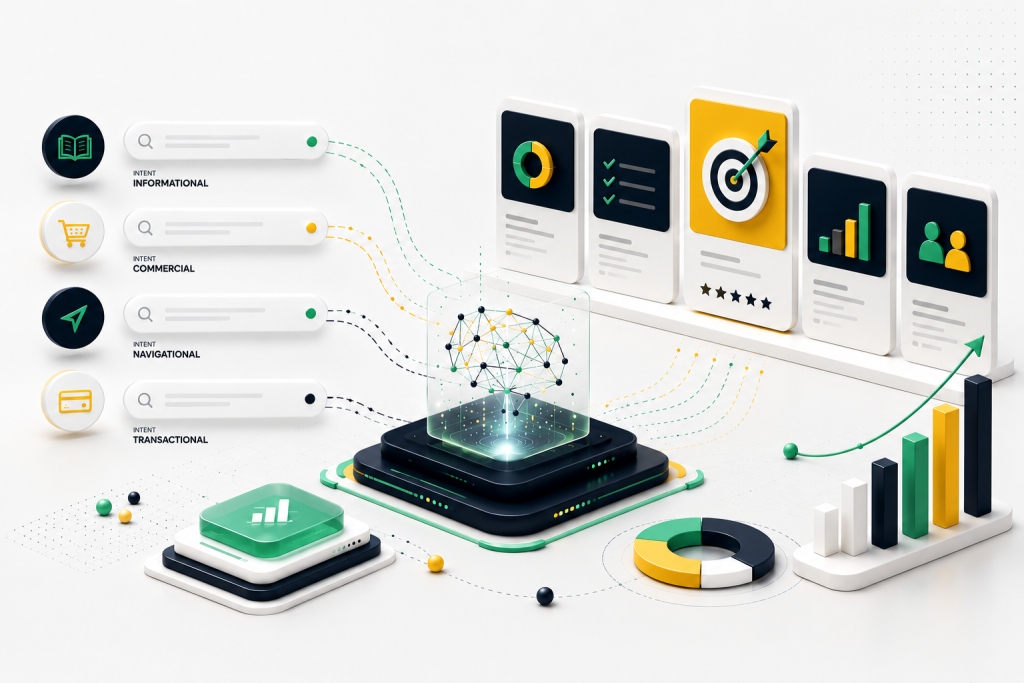
The Four Key Search Intent Categories
Informational Intent
Users are looking for answers, education, or guidance.
Examples:
- What is SEO?
- How does website optimization work?
- What is conversion rate optimization?
Brands that publish helpful, educational content often perform well in these searches.
Consideration Intent
Users are researching and comparing available options.
Examples:
- Best SEO agency for small businesses
- Top web development companies
- Shopify vs WooCommerce
AI often favors businesses that demonstrate:
- Industry expertise
- Strong online reputation
- Detailed service information
- Trust and credibility
Transactional Intent
Users are ready to take action.
Examples:
- Hire an SEO expert
- Website development services
- Request a digital marketing consultation
For these searches, AI may prioritize:
- Service relevance
- Local presence
- Customer reviews
- Conversion-focused content
Navigational Intent
Users already know the company or brand they want to find.
Examples:
- The Web Transformers reviews
- The Web Transformers services
- The Web Transformers contact information
In these situations, AI helps users locate specific information about a known business.
Why Brands Appear for Certain Searches and Not Others
Many businesses assume that ranking for one search term automatically guarantees visibility for all related topics.
AI search doesn’t work that way.
A business might:
- Appear frequently in educational content recommendations
- Rarely appear in service-related searches
Or:
- Perform well for purchase-intent queries
- Struggle to appear during the research phase
This usually happens because content is focused on only one stage of the customer journey.
How AI Evaluates Brand Authority
AI platforms assess multiple signals when determining which brands to recommend.
Topical Authority
Does the brand consistently create valuable content around a specific subject?
Brand Recognition
Is the business mentioned across trusted websites, directories, and online sources?
Content Quality
Does the content provide comprehensive and useful information?
Expertise & Trust
Does the brand demonstrate genuine experience and industry knowledge?
User Value
Does the content effectively answer user questions and provide helpful solutions?
Brands that perform well across these areas are more likely to appear consistently in AI-generated recommendations.
The Challenge of Limited Intent Coverage
Many businesses focus heavily on bottom-of-funnel content such as:
- Service pages
- Sales pages
- Product pages
- Landing pages
While these assets help drive conversions, they often do little to build authority for educational and research-based searches.
As a result, AI platforms may recognize the brand when users are ready to buy but overlook it during earlier stages of the decision-making process.
Building Visibility Across the Entire Customer Journey
To strengthen AI search visibility, businesses should create content that supports every stage of the customer journey.
Awareness Stage
Provide educational content that answers common questions.
Examples:
- What is technical SEO?
- How does website speed affect rankings?
Consideration Stage
Help users compare options and evaluate solutions.
Examples:
- SEO vs PPC
- WordPress vs Shopify
Decision Stage
Create service-focused content designed to drive conversions.
Examples:
- Local SEO Services
- Custom Website Development
Retention Stage
Support existing customers with helpful resources and guides.
Examples:
- Website maintenance best practices
- Understanding SEO performance reports
This comprehensive approach improves visibility across a wider range of AI-generated searches.
The Future of AI Search Optimization
As AI search platforms continue to evolve, businesses must move beyond traditional keyword-focused strategies.
Success will increasingly depend on:
- Search Engine Optimization (SEO)
- Generative Engine Optimization (GEO)
- Answer Engine Optimization (AEO)
- Entity Building
- Content Strategy
- Intent-Based Content Development
Brands that create content for multiple user intents are more likely to:
- Earn AI-generated recommendations
- Increase brand visibility
- Build industry authority
- Strengthen trust and credibility
- Maintain long-term search presence
Ready to Improve Your AI Search Visibility?
At Web Transformers, we help businesses build future-ready digital marketing strategies that improve visibility across traditional search engines and emerging AI-powered platforms.
Our services include:
- Search Engine Optimization (SEO)
- Generative Engine Optimization (GEO)
- Answer Engine Optimization (AEO)
- Technical SEO Audits
- Local SEO
- Content Strategy & Topic Mapping
- Entity Optimization
- AI Search Visibility Consulting
- Website Optimization
- Performance Marketing
Let’s Build a Future-Ready Growth Strategy
Whether you’re looking to improve search rankings, strengthen brand authority, or increase visibility across AI search platforms, our team can help create a strategy that drives sustainable growth and measurable results.